The Blindness of Artists and the Three Stages of Seeing
I was a blind artist, but I didn't realize how much until I brought a few paintings to a prominent gallery that I had been showing with for a couple of years. I showed the work to the gallery owner, who was herself a successful artist. It was like a knife in my heart when she said, "This isn't you," and refused to take the work.
I knew deep down she was right. But I didn't know what to do about it. I had been painting for a number of years, drawing and painting from life constantly.
All that work was priceless, but I lacked some serious knowledge. And that blind spot eventually led me to another embarrassing, deeply discouraging moment that had me considering quitting altogether. I was blind, and I didn't know why or how to fix it.
Over the years, I've observed changes in the way I see as an artist. And as a teacher watching the struggles and progress of many students, I've come to believe that there are two broad categories every artist must become competent in to achieve mastery.
The first is obvious to most people, and many beginners mistakenly assume it's all they need to worry about. This is technique, mastering the use of materials. Newer artists often search for some secret pigment, tool, or trick that will unlock the same results as the masters. And to be fair, materials do matter. I paint with much greater ease on non-absorbent, lead-primed linen than on highly absorbent universal-primed canvas. Learning how to hold a brush, and how to vary angle and pressure to achieve a particular look, took real time and attention.
But no matter how good your materials are, or how well you wield a brush, if you don't master the second category, none of it will matter.
The second, and most important category is learning how to see. And in my experience, there are three distinct stages every artist must pass through to reach what I call intuitive mastery.
Stage 1: Seeing What You Think You See
Most artists begin with a high degree of mental blindness. When they look at the world in front of them, they aren't really seeing what's there. They're seeing words.
They look at a tree and the word "green" forms in their mind, the same green in their tube of Sap Green. They see a shadow and think "dark," so they reach for Ivory Black or Payne's Gray. If they're a bit more advanced, they might use a cool color. But they rarely achieve a true representation of what is actually there.
This is because they are painting the word, not the thing.
When something triggers a word, "dark," "green," "eye", they put that word's symbol on the canvas without really looking. If they're drawing a face, they see an eye and draw a horizontal almond shape with a circle in it. They're not drawing what's in front of them; they're drawing the symbol their mind has associated with the word "eye."
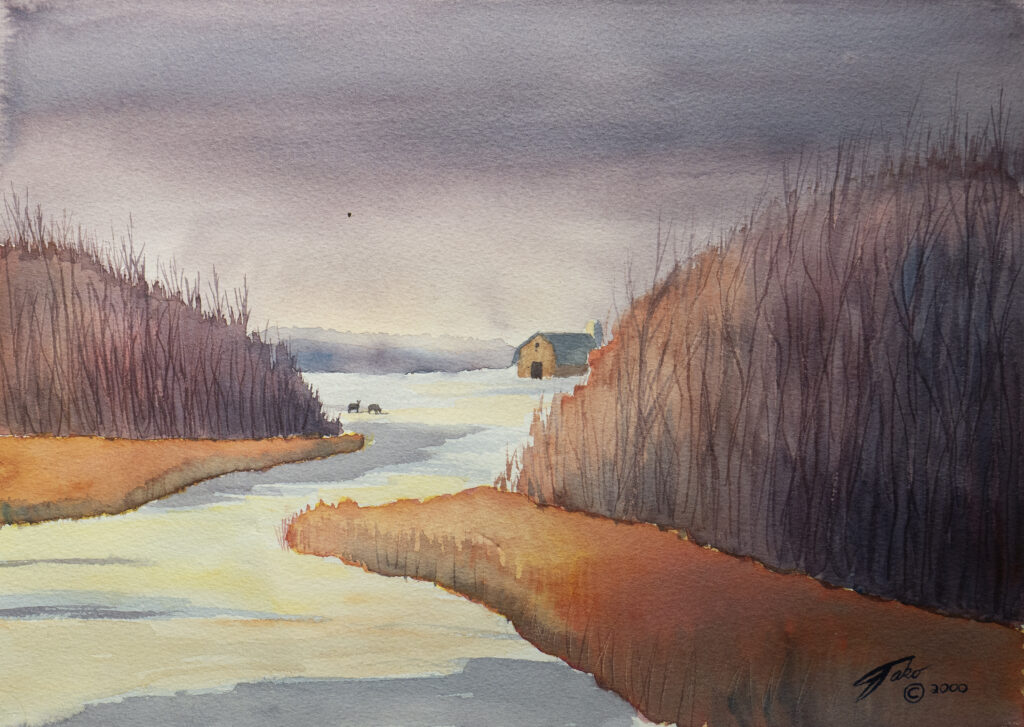
Above is one of my first watercolor paintings when I started back up as an artist in my late 20s. A great example of painting how I thought a mass of trees and grass looked on a winter evening , rather than how they actually look. The funniest thing is I had the audacity to put a copyright symbol on this.
The visual world, especially color, which consists of millions of combinations of hue, value, and saturation, outruns language almost immediately. Our vocabulary simply cannot describe everything the eye and brain can actually perceive. So when we rely on words to see, we miss almost everything.
This is completely normal. Richard Schmid wrote about it in his classic book Alla Prima. And for most people, it takes real time and effort to overcome. The key is to slow down, quiet the word-forming habit, look at what is actually there, and gradually develop a new internal vocabulary, one built on direct observation rather than labels.
Stage 2: Seeing What Is Really There
The second stage is when an artist has developed the ability to successfully copy what they are seeing.
For the representational artist, this is an essential milestone. If you want to paint something convincingly, you have to make a reasonable likeness of it on your canvas. This is why ateliers, past and present, have students spend countless hours doing master copies and painting from life. Success is measured by how close the painting comes to the subject, and that makes complete sense, because it forces the student to break free from the word-and-symbol blindness of Stage 1.
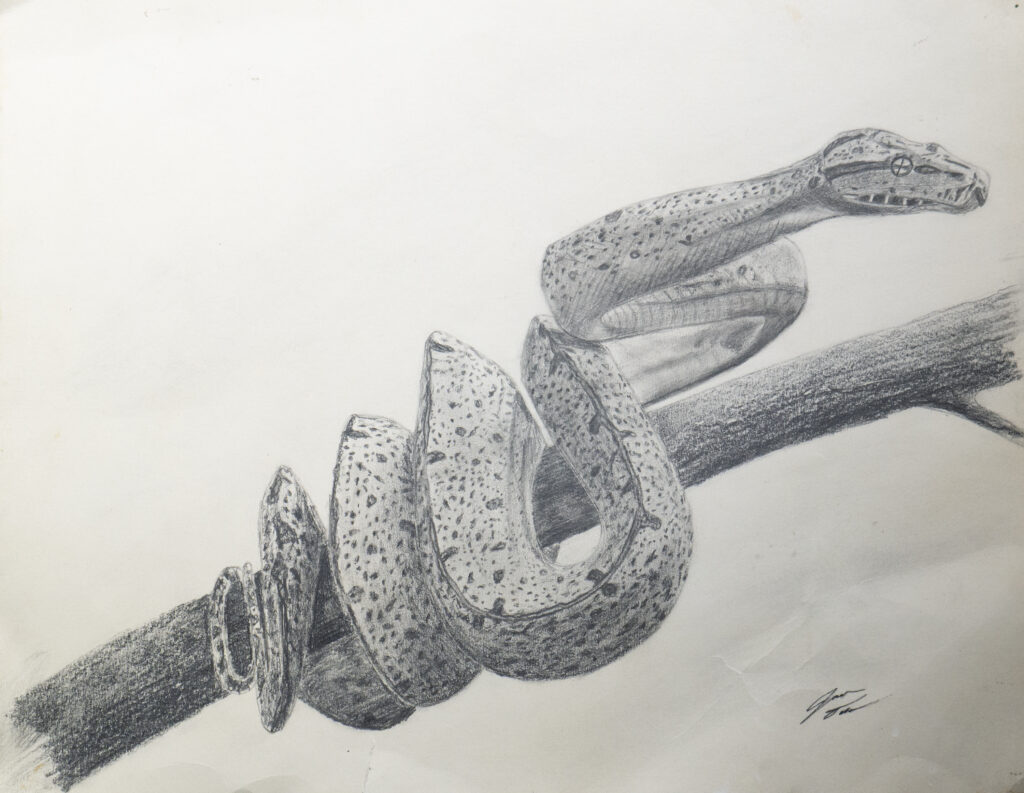
This is a drawing I did way back in middle school—copied from a magazine. Unlike my previous watercolor, I painstakingly copied every single spot on that snake as precisely as I could. It took forever. No artistic expression, just copying.
But most artists don't want to stay here. Copying can be technically impressive while still lacking expression. And yet in any representational endeavor, mastering the art of copying precedes expression. Every musician starts out playing someone else's music. Eventually, they develop their own sound.
Which brings us to the third stage.
Stage 3: Seeing What You Want to See
This is different from Stage 1, and the difference matters.
Stage 1 results from limitation, from the blindness of not truly seeing what is there. Stage 3 results from choice — from a developed sense of expression built on the foundation of having mastered Stage 2.
In Stage 3, the artist sees what is actually there, but makes deliberate decisions about what to alter, emphasize, or leave out — all in service of personal expression. They are seeing not just with their eyes, but with their emotions. What they perceive and put on the canvas goes beyond words and even beyond technique. Technique becomes the servant of vision, not the other way around.
And unlike Stage 2, they are no longer constrained to copying what is in front of them. In Stage 3, the artist paints primarily from intuition.
One painter may saturate the color in a scene because they are moved by it and want the viewer to feel that same intensity, think Monet. Another may deliberately neutralize the color because restraint suits their temperament and vision. Another may love form above all and subordinate color to drawing, think Sargent. And another may want to render the scene as faithfully as possible because they find the world itself beautiful enough without alteration. In each case, the artist is seeing what they want to see and painting what they want others to see. We call this style. We call it voice.
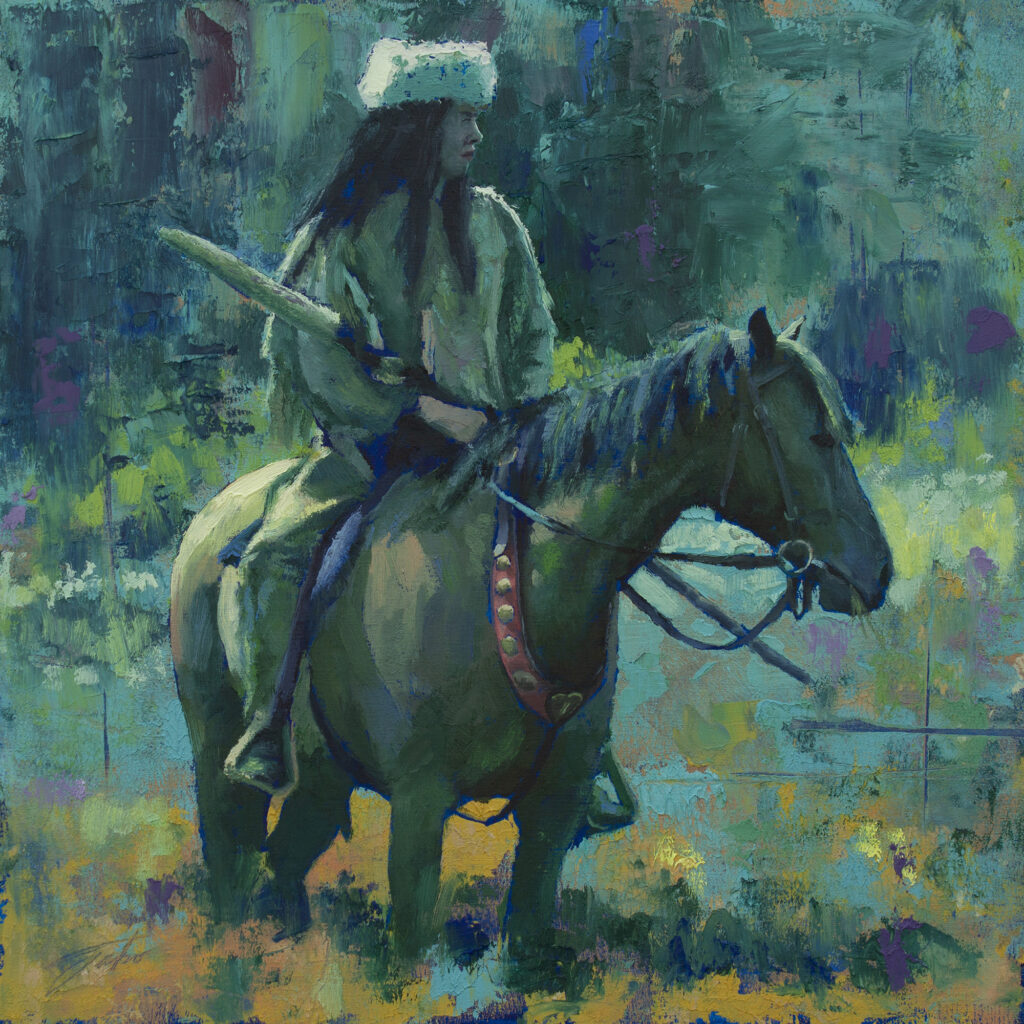
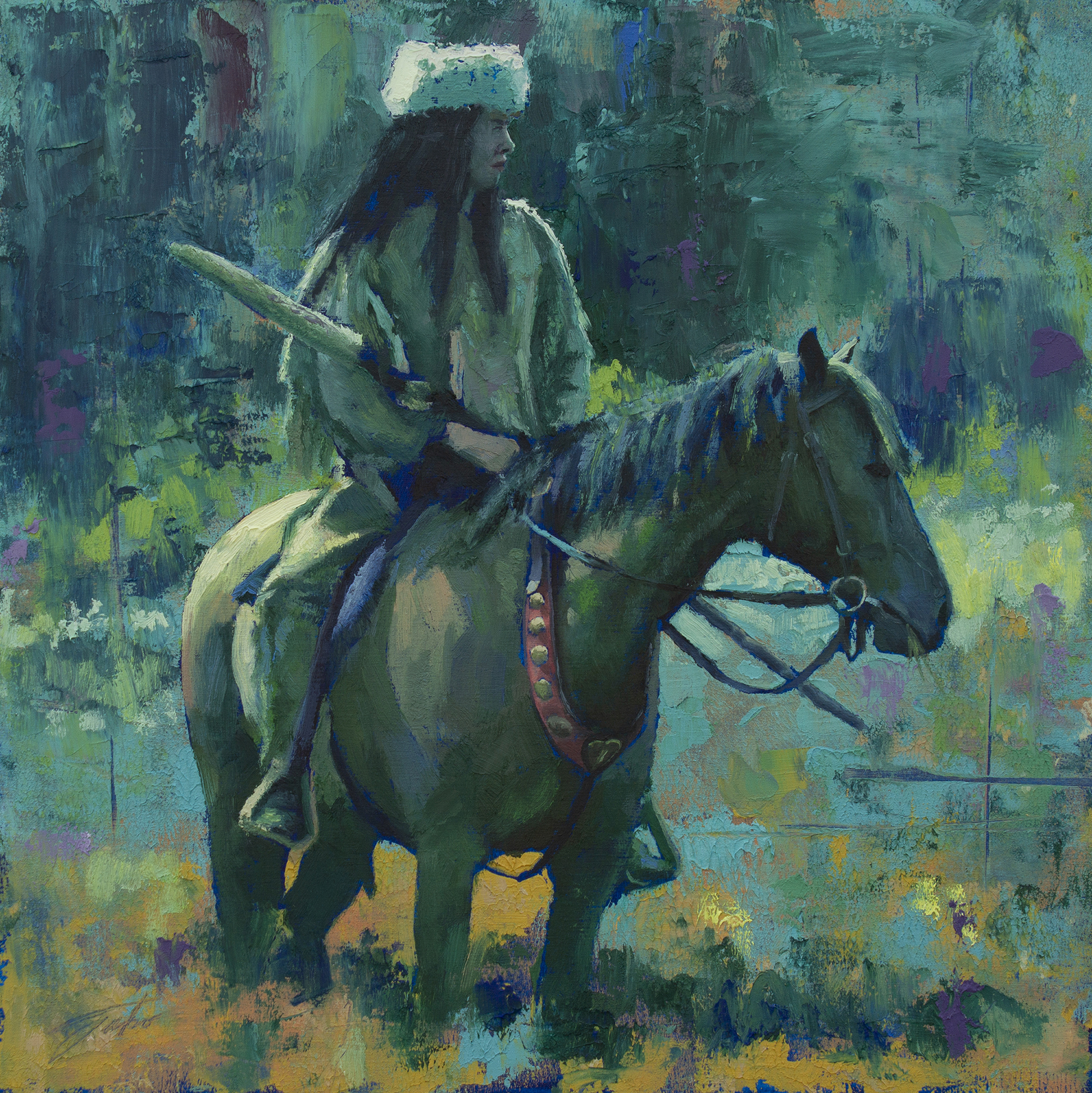
This is a good example of seeing what I wanted to see. I didn’t paint the colors literally, rather I interpreted the color and value relationships to be suggestive and emphasize a mood. This is oil and cold wax on 12x12 wood panel.
Learning to See Is Not Just Intellectual
The challenge isn't only getting your logical mind to stop playing the word game. It's also quieting your emotions.
You cannot truly see what is there, and you certainly cannot reach a place of seeing what you want to see, if you're worried about whether you can actually paint, what a gallery will think, or how many likes a post will get. Arriving at Stage 3 requires a balance of technical knowledge, theoretical understanding, accumulated experience, and hard-won confidence. It is not a quick journey. But it is an essential one, if you want to create work that you are genuinely proud of, work that expresses what is inside you rather than what you think is expected of you.
Going back to the story I started with.
Plein Air Easton had just ended. I hadn't won any awards, and I hadn't sold much. In a moment that I can only describe as a combination of boldness and blind stupidity, I went back to that same gallery — which was in Easton, whose owner had also participated in the event, to see if she wanted any of the unsold work.
Nothing like bringing paintings that didn't sell at one of the biggest plein air events in the country to a gallery in that same town.
My heart sank when I arrived and saw several successful painters bringing their work in and watching the gallery owner's face light up. My work did not receive the same welcome. It simply didn't have the same life. I knew I had to do something. The path I was on wasn't working.
I had taken two workshops before this: a one-day workshop with Rod Crossman, and a week-long workshop with Albert Handell, where I had the remarkable experience of meeting Richard Schmid and receiving a personal critique from him. Both workshops were inspiring and informative. I had also done a great deal of reading. I knew the fundamentals intellectually. I could tell you what Carlson said about angles, consequent values, and color relationships.
I thought I just needed to keep practicing. But that was only half the answer. Practice is essential, but I was still blind to my own work.
Out of frustration, I decided to bite the bullet and sign up for a ten-day landscape painting workshop with master artist Scott Christensen. I flew out to Idaho, and on the very first day, Scott said something that had the effect of scales falling from my eyes. It wasn't directed at my work specifically, but it hit me like a tidal wave. It was about color relationships, how one color affects the appearance of another, and why restraint with color saturation is essential, especially when you want to show truly intense color. I had heard this concept before. I had even read about it. But the way Scott explained and demonstrated it was a revelation.
And that was just day one.
Everything crystallized further when I watched Scott critique the group's work. There is a profound difference between reading about a concept and watching it come to life in front of you.
I went back to Plein Air Easton the following year and won two major awards, Best Architectural Painting and the Vanishing Landscape Award, which was a people's choice award that year. My auction painting sold for nearly three times its market value.
I am still on Stage 3, and I expect I will be for the rest of my painting life. Stage 3 is probably the most challenging of all, not because it requires more technique, but because it is not objective. It takes courage, especially when your way of seeing is not immediately understood or popular.
But you cannot skip Stage 1 and Stage 2. You shouldn't want to. Mastering those stages is what gives you the confidence, and the freedom, to journey through Stage 3.
Paint well,
Warning: Undefined array key "preview" in /home3/mysketc2/public_html/wp-content/plugins/oxygen/component-framework/components/classes/comment-form.class.php on line 75
Warning: Undefined array key "preview" in /home3/mysketc2/public_html/wp-content/plugins/oxygen/component-framework/components/classes/comment-form.class.php on line 79